
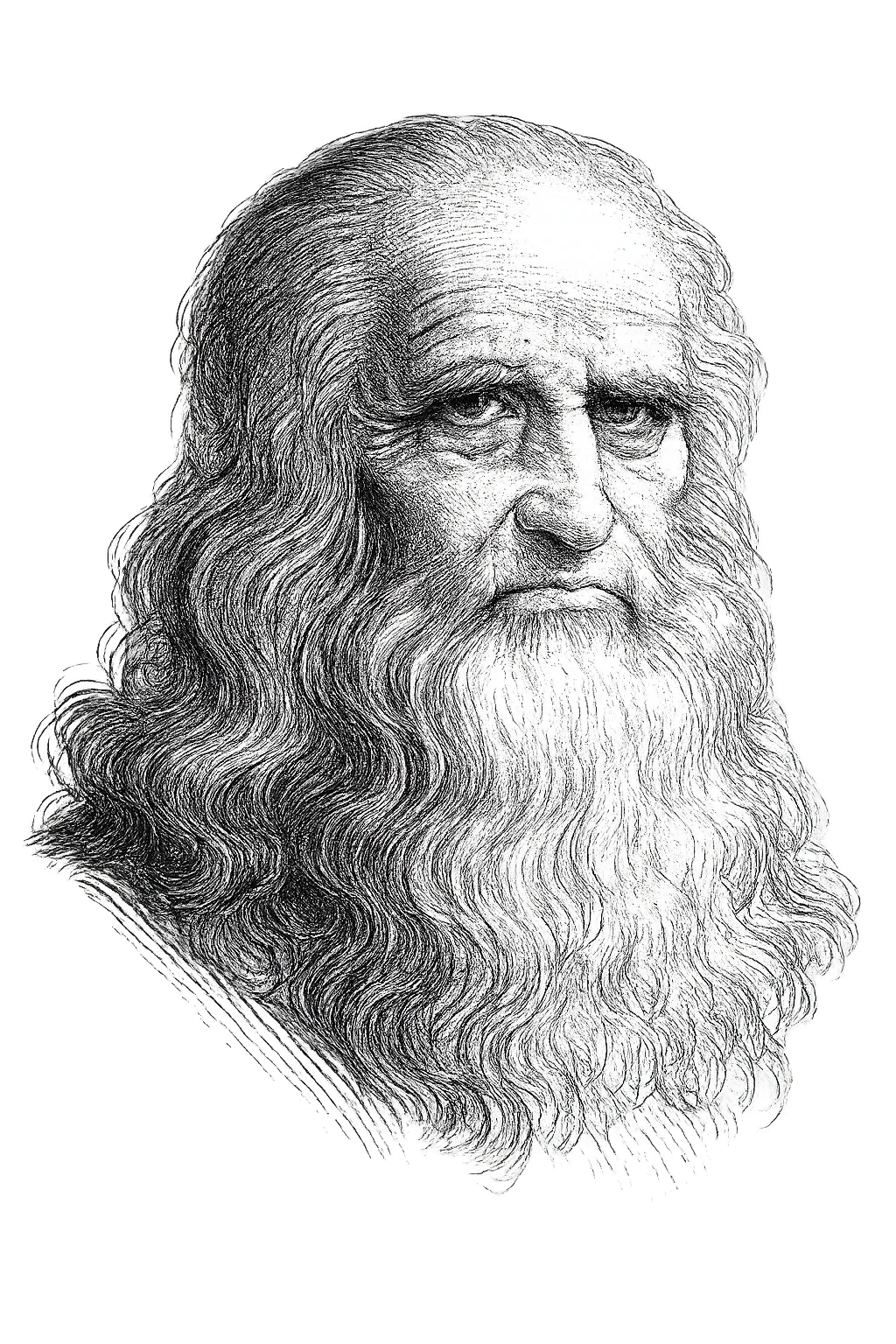
Artist · Scientist · Engineer · Inventor
1452–1519
“Though human ingenuity may make various inventions, it will never devise any inventions more beautiful, nor more simple, nor more to the purpose than Nature does; because in her inventions nothing is lacking and nothing is superfluous.”
— Leonardo da Vinci
Who Was Leonardo da Vinci?
Leonardo da Vinci is often remembered as the painter of the Mona Lisa and The Last Supper.
Yet painting was only a small part of his life’s work.
Leonardo believed that knowledge begins with experience.
He distrusted conclusions reached without observation and repeatedly turned to nature as the ultimate teacher.
Throughout his notebooks he studied water, flight, anatomy, light, plants and machines, seeking to understand how things actually worked rather than how people assumed they worked. His notebooks contain thousands of pages of sketches, observations, experiments, and inventions. Many of his designs anticipated technologies that would not appear for centuries.
Why Leonardo Matters
Many thinkers become specialists. Leonardo moved freely between:
- Art and science
- Observation and imagination
- Beauty and utility
- Theory and practice
Today we often separate these domains. Leonardo treated them as one.
- To understand a bird was to study flight.
- To study flight was to understand mechanics.
- To understand mechanics was to understand geometry.
- To understand geometry was to better understand beauty.
Everything connected.
Reflection
It is not about accumulating beliefs. It is about learning how to see. Leonardo reminds us that reality is usually more interesting than our assumptions about it. The challenge is not merely to think.
Reality can correct us.
Before certainty:
Observe.
Before judgement:
Observe.
Before conclusion:
Observe.
“Wisdom is the daughter of experience.”
— Leonardo da Vinci
References
- The Notebooks of Leonardo da Vinci, translated and edited by Jean Paul Richter, Dover Publications.
- The Complete Paintings and Drawings of Leonardo da Vinci, Frank Zöllner and Johannes Nathan, Taschen.
- Victoria and Albert Museum, “Leonardo da Vinci’s Notebooks”
Victoria and Albert Museum – Leonardo’s Notebooks - The British Library, Leonardo da Vinci Collection and Manuscripts
British Library – Leonardo da Vinci Collection - Leonardo da Vinci, Walter Isaacson, Simon & Schuster, 2017.