
Introduction
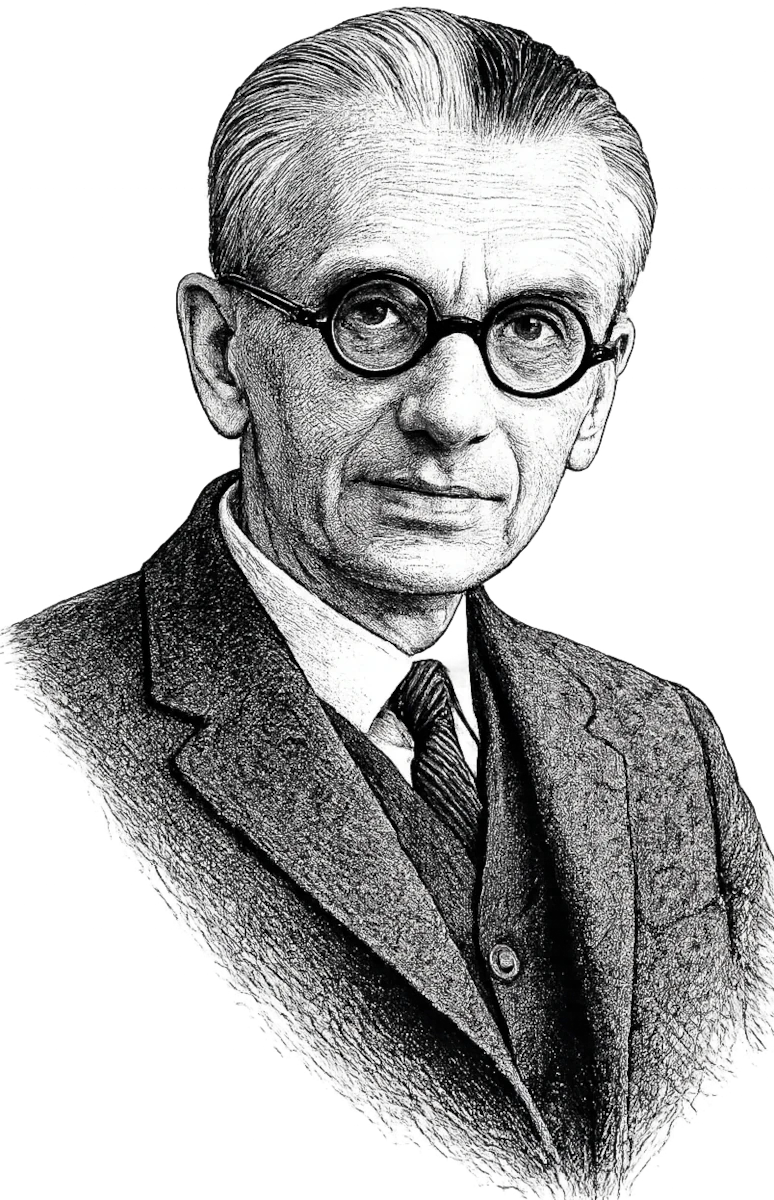
Kurt Gödel (1906–1978) was an Austrian logician, mathematician, and philosopher whose work transformed the foundations of mathematics and logic.
He is best known for the Incompleteness Theorems, published in 1931, which demonstrated that any sufficiently powerful formal system contains true statements that cannot be proven within the system itself.
Gödel’s discoveries are widely regarded as among the most important intellectual achievements of the twentieth century and continue to influence mathematics, computer science, philosophy, and discussions about the nature of knowledge and reality.
Early Life
Kurt Friedrich Gödel was born on 28 April 1906 in Brünn, Moravia, then part of the Austro-Hungarian Empire (now Brno in the Czech Republic).
As a child he displayed an intense curiosity and a habit of questioning accepted explanations. Family members reportedly nicknamed him “Herr Warum” (“Mr Why”) because he constantly asked why things were the way they were.
Gödel studied at the University of Vienna, where he became associated with the intellectual environment surrounding the Vienna Circle, a group interested in logic, science, and the foundations of knowledge.
Although he interacted with members of the Vienna Circle, he did not share their belief that all meaningful knowledge could be reduced to logical or scientific verification.
The Incompleteness Theorems
In 1931, at the age of twenty-five, Gödel published his Incompleteness Theorems.
At the time, many mathematicians hoped that all of mathematics could be placed on a complete and consistent logical foundation.
Gödel proved that this goal could never be fully achieved.
His First Incompleteness Theorem showed that any sufficiently powerful and consistent formal system contains true statements that cannot be proven within that system.
His Second Incompleteness Theorem showed that such a system cannot prove its own consistency.
These results fundamentally changed the study of logic and the philosophy of mathematics.
Relationship with Einstein
After emigrating to the United States, Gödel joined the Institute for Advanced Study in Princeton, New Jersey.
There he developed a close friendship with Albert Einstein.
Einstein reportedly remarked that his own work at the institute had become less important than the opportunity to walk home with Gödel and discuss philosophy and science.
The two shared a deep interest in the nature of reality, time, and the limits of human understanding.
Gödel later applied mathematical methods to questions in physics and produced solutions to the equations of general relativity that explored unusual possibilities involving time and causality.
Philosophy and Beliefs
Gödel believed that mathematical truths are discovered rather than invented.
He held a philosophical position often described as mathematical realism or Platonism, the view that mathematical objects and truths exist independently of human minds.
He was also deeply interested in philosophy, theology, and metaphysics.
Unlike many twentieth-century intellectuals, Gödel believed that reality contained objective truths that could not be reduced solely to physical processes.
He explored arguments concerning the existence of God, the nature of consciousness, and the possibility that human understanding might extend beyond purely mechanical computation.
Although these views remain controversial, they formed an important part of his intellectual life.
Later Life
Gödel struggled throughout his life with periods of anxiety, depression, and poor health.
He became increasingly cautious and suspicious, particularly regarding food and personal safety.
In his later years he developed a severe fear of poisoning and would often eat only food prepared by his wife, Adele.
When Adele became ill and was unable to care for him, Gödel’s fears contributed to a refusal to eat adequately.
He died on 14 January 1978 in Princeton, New Jersey, from complications related to malnutrition.
His death remains one of the more tragic episodes in the history of modern science.
Legacy
Gödel’s work permanently altered the understanding of mathematics and formal reasoning.
His ideas influenced later developments in:
- Mathematical logic
- Computer science
- Computability theory
- Artificial intelligence
- Philosophy of mathematics
- Epistemology
His Incompleteness Theorems remain a reminder that even the most powerful systems have limits.
Far from weakening mathematics, Gödel revealed both its extraordinary power and its inherent incompleteness.
Today he is widely regarded as one of the greatest logicians in history.
Selected Contributions
- Incompleteness Theorems (1931)
- Completeness Theorem (1929)
- Contributions to set theory
- Work on the foundations of mathematics
- Gödel universe solutions in general relativity
- Philosophical work on logic, truth, and mathematical realism
Key Idea
A common summary of Gödel’s contribution is:
No sufficiently powerful formal system can contain all mathematical truths about itself.
His work demonstrated that certainty has limits, while discovery does not.
For this reason, Kurt Gödel remains one of the most influential thinkers of the modern age.